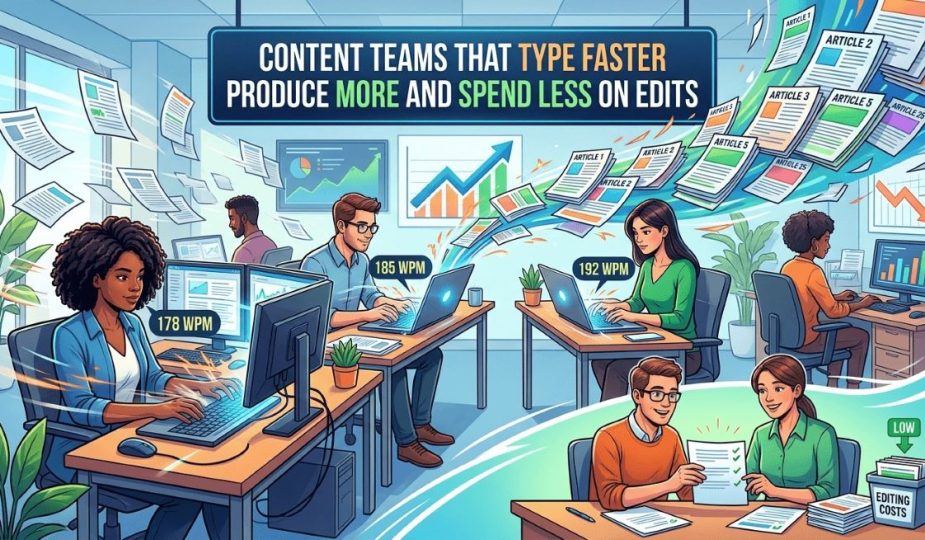
Most content managers obsess over editorial calendars, topic clusters, and keyword strategies. Few stop to measure the one variable sitting right under their fingers. Typing speed. It sounds almost too basic to matter. But when you do the math, it turns out that a writer who types at 75 words per minute produces meaningfully more usable content per hour than one who types at 45. That gap compounds across a team of five, across a week of sprints, across a quarter of publishing. The numbers get uncomfortable fast.
ROI Snapshot
- A 30 WPM gap between two writers creates hours of lost output per week.
- Slow typists self-edit mid-sentence, increasing revision load for editors.
- A single internal benchmark test can surface this gap in under two minutes.
- Output velocity is a measurable, trainable variable, not a fixed personality trait.
Why Output Velocity Is a Real Cost Driver
Content marketing has a unit economics problem that nobody wants to talk about. The cost-per-word on your team is not just about hourly rates. It is about how many words actually get produced per hour billed.
A writer billing at $40 per hour who produces 600 publishable words in that hour costs you about $0.067 per word. A writer at the same rate who produces 900 words in that same hour costs you roughly $0.044 per word. That is a 34% difference in effective cost per word, for the exact same pay rate.
Scale that across a ten-article week and the gap becomes a budget conversation. Scale it across a team of four or five writers and it becomes a hiring strategy conversation.
Typing speed is not the only factor here. Research time, tone confidence, and subject familiarity all matter. But when two writers have similar knowledge and experience, typing fluency often accounts for most of the output difference.
The Hidden Revision Tax on Slow Typists
There is another cost dimension that is easy to miss. Slow typists do not just produce fewer words per hour. They tend to produce messier drafts.
This happens because typing slowly creates cognitive friction. The writer’s thoughts move faster than their fingers, which forces a kind of mental buffering. To manage that buffer, many writers start self-editing mid-sentence. They stop, delete, rephrase, stop again. The result is a draft that looks thought-out on the surface but is actually fragmented underneath. Sentences that trail off. Paragraphs that contradict themselves. Arguments that lose their thread.
Your editor then inherits that cognitive friction as revision work. A draft written at low typing speed often takes 20 to 30 percent longer to edit than a draft written at fluent speed, even if both drafts are the same word count.
When you factor editing time into your cost-per-word calculation, the gap between fast and slow typists widens even further.
Setting a Team Baseline During Hiring and Onboarding
The good news is that typing speed is measurable. You do not need to run a lengthy assessment or install expensive software. A one-minute test gives you a clean words-per-minute baseline in about 90 seconds of a candidate’s time, and it costs nothing.
Building this into your hiring process does not mean rejecting anyone below a certain WPM threshold. It means having a baseline to work from. Here is how smart content teams use this data:
- Screen at the application stage by including a voluntary WPM test as part of a short writing skills questionnaire.
- Set role-specific benchmarks, for example 60 WPM minimum for blog writers, 75 WPM for social media editors who produce at volume.
- Use results during onboarding to recommend typing practice before a new hire starts their first content sprint.
- Track improvement over time by retesting quarterly as part of a professional development review.
- Use the baseline in workload planning by assigning higher-volume days to faster typists and research-heavy days to those still building speed.
Framing the test as a productivity tool rather than a gatekeeping mechanism matters. Writers respond well when you position it as part of their growth plan, not a pass-or-fail filter.
What a Realistic Typing Speed Target Looks Like for Content Teams
Industry Benchmarks Worth Knowing
Average adult typing speed sits around 40 WPM. Professional writers who type regularly tend to cluster between 60 and 80 WPM. Experienced content marketers who produce multiple pieces per day often reach 80 to 100 WPM or higher.
| Role | Recommended Baseline | Target After 90 Days |
|---|---|---|
| Blog Writer | 55 WPM | 70 WPM |
| Social Media Editor | 65 WPM | 80 WPM |
| Content Strategist | 50 WPM | 65 WPM |
| Copywriter | 65 WPM | 85 WPM |
These numbers are not rigid rules. They are useful anchors for conversations about productivity expectations and training investment.
Tackling Writer’s Block During High-Volume Content Sprints
Speed matters less when a writer is staring at a blank page. Writer’s block is a real productivity drain during sprint weeks, and it hits even experienced writers hard when volume targets are high and topic variety is low.
One underrated trick is using a word generator as a creative warm-up before a session. The idea is not to use the generated words literally in your article. The idea is to break the mental freeze by forcing a few sentences of associative writing. You get three random words, you write two sentences connecting them, and suddenly your fingers are moving and your internal editor has stood down.
Content teams that build this into their sprint routine report that writers reach their productive flow state faster. Instead of spending the first 15 minutes circling around an opener, they spend 3 minutes doing a word association warm-up and then dive straight in.
That 12-minute difference, multiplied by six articles a week, adds up to over an hour of reclaimed writing time per writer per week.
Building a Speed-Aware Content Culture
Speed awareness does not mean turning your content team into a race. It means treating typing fluency as a professional skill that is worth developing, the same way you treat research skills, headline writing, or SEO knowledge.
Here are practices that teams have used successfully:
- Run a voluntary team-wide WPM test during a team meeting and discuss results openly without judgment.
- Create a shared typing practice habit, even 10 minutes before a sprint day starts.
- Track WPM alongside other productivity metrics in your content team dashboard.
- Celebrate WPM improvements as wins in team retrospectives.
- Factor in typing speed when estimating deadlines and sprint capacity.
The goal is to make speed something the team thinks about, practices, and improves on purpose. Not a talent. A skill.
Accuracy Matters As Much As Raw Speed
A writer typing at 90 WPM with 85% accuracy produces more correction work than one typing at 70 WPM with 98% accuracy. Raw speed without accuracy still adds revision overhead.
When you benchmark your team, look at both numbers. WPM is the headline, but accuracy rate tells you whether that speed is actually saving time or just moving the error-correction work downstream to your editors.
How This Changes Your Capacity Planning
Once you have a WPM baseline for each writer, you can build more accurate sprint capacity models. Instead of estimating by article count alone, you can estimate by writer-hours needed per word count target, adjusted for each person’s documented output velocity.
This makes your editorial calendar more realistic. It reduces the overcommitment problem that plagues content teams every quarter. And it gives writers a fair, data-backed explanation for why some weeks are heavier than others.
It also shifts performance conversations from “you missed the deadline” to “our velocity model showed a gap and here is how we address it.” That is a much healthier conversation to have with a writer.
When Faster Fingers Pay the Whole Team’s Bills
Content teams live and die by throughput. Every article that ships on time is an asset. Every article delayed for a revision cycle is a cost. Every piece underwritten because a writer ran out of time is a missed ranking opportunity.
Typing speed sits at the foundation of all of that. It is not glamorous. It does not show up on a brand brief or a strategy deck. But it is one of the few productivity levers a content manager can actually measure, benchmark, and improve with minimal investment.
Teams that take it seriously end up producing more output per dollar spent. They revise less. They burn out less. And their cost-per-word numbers make the finance team ask fewer uncomfortable questions.
That is a competitive edge that costs nothing to build and compounds every single week.